Mills publishes first-of-kind delivered (DTW) fuel price assessments
The Mills Assessed Delivered (MAD) Price extends the Mills Assessed Rack Clearing (MARC) Price to create a transparent delivered / DTW price for wholesalers and jobbers who quote delivered fuel prices and fuel buyers who need to benchmark quotes from suppliers

NEW YORK, Sept. 15, 2026 -- Mills Price, LLC today launched Mills Assessed Delivered (MAD) Prices, the first published benchmark for the delivered fuel market, pricing each covered zip code and truck class twice a day in the Mills Delivered Price Report and Atlas.
The delivered fuel market has never had a published reference price. A retailer or commercial fleet buying fuel on a rack index plus an adder sees one number. That adder bundles freight, taxes, a fuel surcharge, and supplier margin, and no two quotes bundle them the same way. Buyers cannot compare quotes on a common basis. Jobbers build each delivered quote by hand from a rack price, a freight estimate, and a tax table, and the freight estimate is often a phone call to the truck dispatcher.
MAD Prices change that. A MAD Price is the published MARC rack price of a zip code's origin rack terminal city, plus the Mills Fuel Freight Index for the road distance and truck class, plus federal and state motor-fuel excise taxes. The result is a delivered cost index on an unbranded, gross-volume, gross-terms basis. MAD prices can be referenced in DTW supply contracts the same way MARC is referenced at the rack.
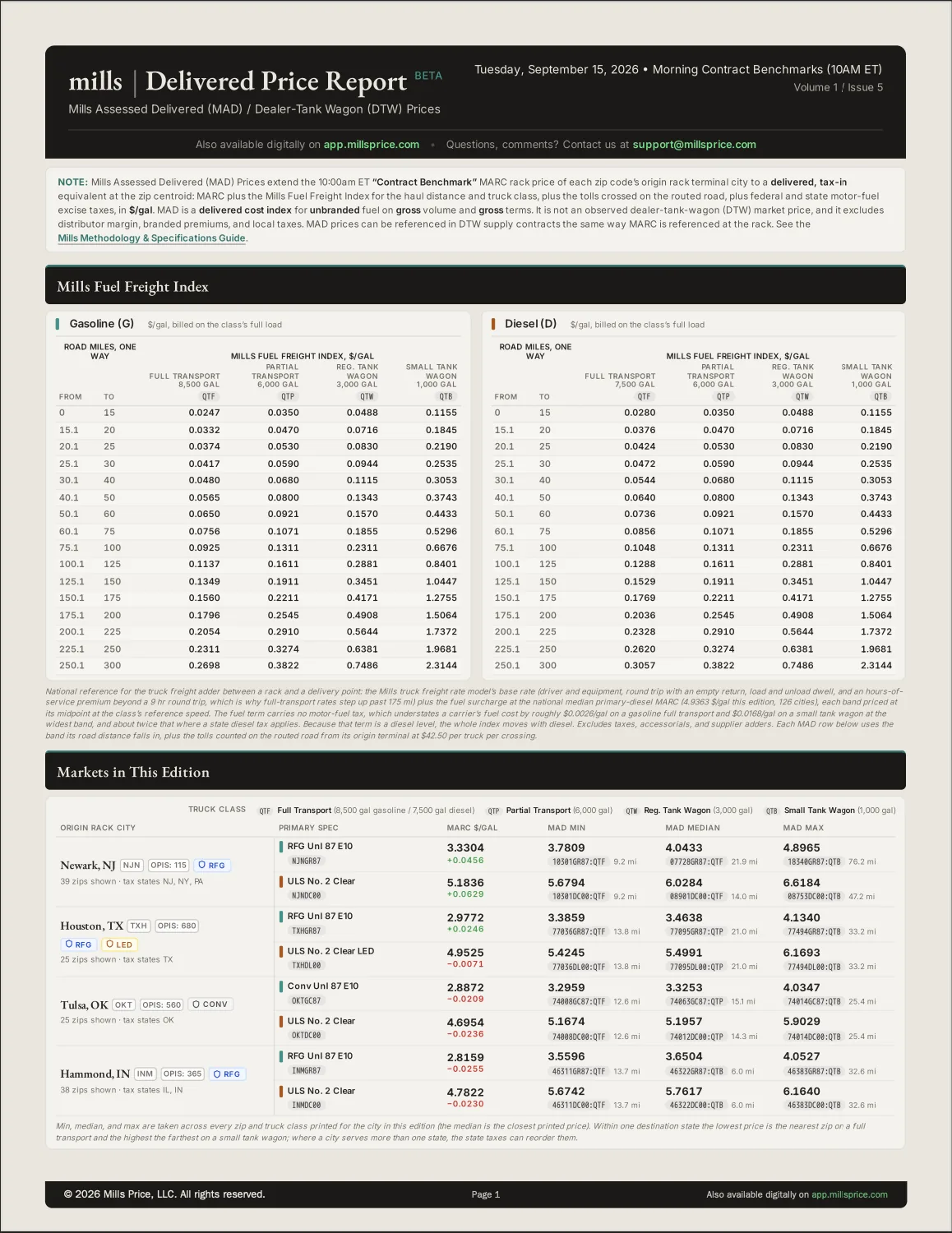
MAD publishes with each MARC edition for four truck classes: Full Transport (QTF, 8,500 gallons of gasoline or 7,500 of diesel), Partial Transport (QTP, 6,000), Regular Tank Wagon (QTW, 3,000), and Small Tank Wagon (QTB, 1,000). The Mills Fuel Freight Index is derived from jobber quotes, common carrier freight rates, and the Atlas Geospatial routing network, priced by truck class and mileage band. Each edition prints the index and the taxes for every zip code, so both sides of a quote can see the freight and tax components separately.
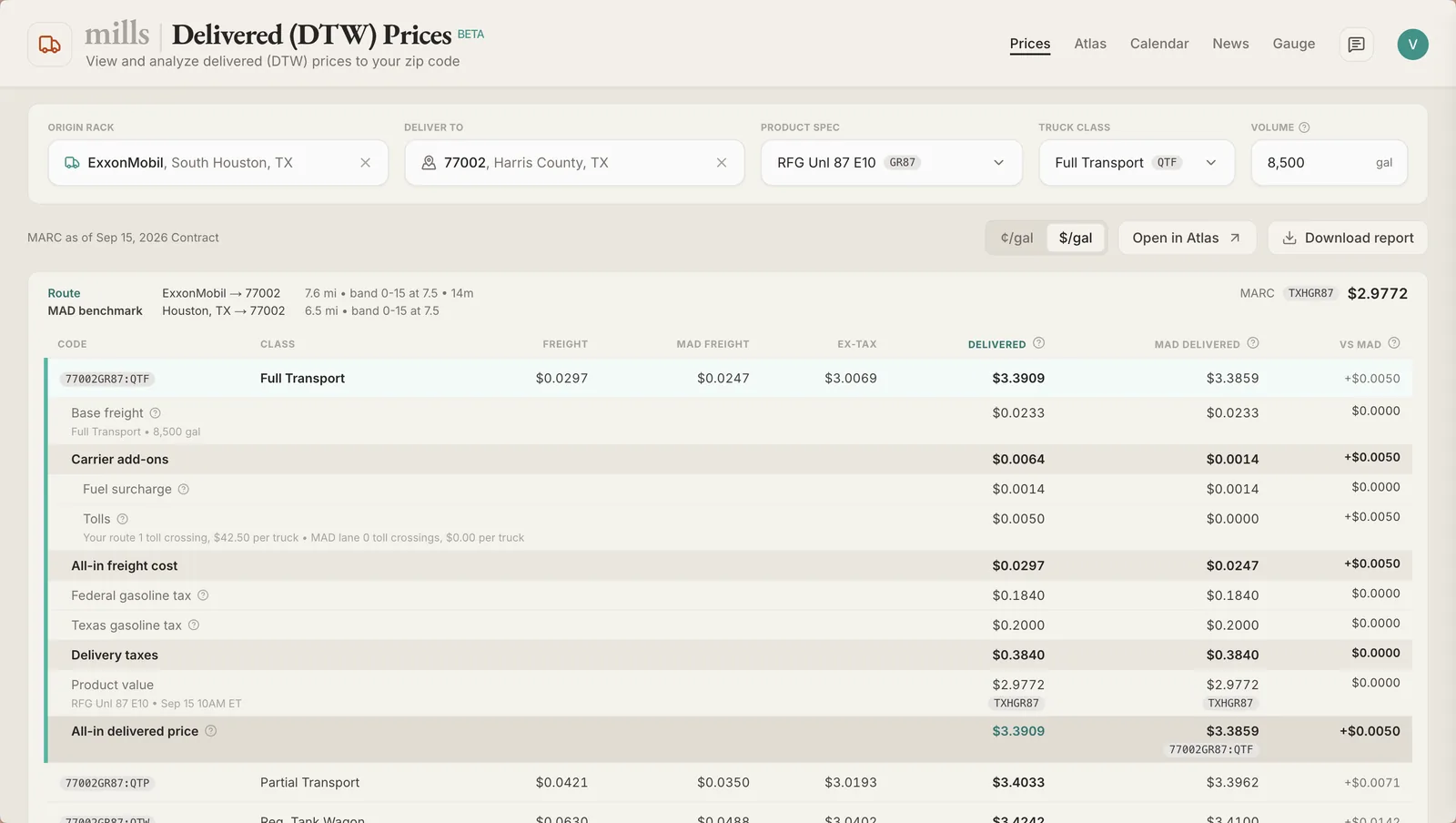
Each MAD Price is identified by a code (zip code, product spec, colon, and truck class), so both parties to a DTW contract can cite the exact price point. For example, 07002GR87:QTF is RFG Unleaded 87 E10 delivered to the New Jersey zip code 07002 on a Full Transport load of 8,500 gallons, with federal and New Jersey taxes included. For fuel quantities outside the four standard truck class bands, the Mills Delivered (DTW) Price Calculator at app.millsprice.com/delivered enables further personalization and custom indexing by load size.
“Fuel trades in one futures market, about seven spot markets, about 400 rack markets, and more than 100,000 delivered markets. Assessing delivered prices used to be impossible. But with Mills’ proprietary Atlas Geospatial Ontology and the Weaver Pricing Engine, the Mills pricing team was able to extend the jobber quotes and common carrier fuel freight rates reported to us into a generalizable Fuel Freight Index. No other price agency publishes a delivered / DTW fuel benchmark. A jobber can now price a load in seconds, and a buyer can see the actual cost to their supplier and focus on negotiating the margin.”
Michael Hoffmann, Co-Founder and Head of Price Desk at Mills Price
MAD Prices publish with each MARC edition, at 10:00 am ET and 4:59 pm ET. The General MAD Report covers 127 zip codes around four origin rack cities: Newark, N.J.; Houston; Tulsa, Okla.; and Hammond, Ind., each priced for two products and four truck classes. MAD coverage is not limited to those zip codes or cities. Subscribers can personalize their MAD Report to any rack terminal cities and delivery zip codes they follow. Atlas delivered pricing lets a user compare three origin terminals side by side and export the full cost breakdown to an editable workbook.
Free for verified refined-products market participants during the Initial Release Period.
support@millsprice.com | ICE Chat: Mills Price Desk | millsprice.com. Methodology and coverage at millsprice.com/methodology.
- What is a MAD Price?
- Mills Assessed Delivered (MAD) Prices are built on Mills Assessed Rack Clearing (MARC) Prices, the rack benchmark Mills publishes twice each trading day. A MAD Price is the published MARC rack price of a zip code's origin rack terminal city, plus the Mills Fuel Freight Index for the road distance and truck class, plus federal and state motor-fuel excise taxes, in dollars per gallon. It is a delivered cost index on a wholesale, unbranded, gross-volume, gross-terms basis, printed to four decimals. It is not an observed dealer-tank-wagon (DTW) market price, and it excludes distributor margin, branded premiums, and local taxes. "Delivered" is the general term for a rack-to-site truck price in any truck class, and dealer tank wagon (DTW) is the last-mile subset: the delivered price a dealer pays for fuel trucked to the site, usually on the tank wagon classes.
- Who is it for?
- Jobbers first: the owner, supply manager, or inside sales rep at a local or regional distributor who quotes delivered loads by transport and tank wagon and wants a delivered number in seconds instead of a freight phone call. Retail supply desks and fleet or commercial buyers second: they buy delivered fuel on a rack-plus-adder or fixed quote and want to check it against one published number. A public buyer whose bid asks for a delivered price can read the same number for the zip code and the truck class the bid names. Atlas delivered pricing has the same two uses: a quick delivered quote for a jobber's customer and a check on whether a supplier's delivered quote is in line.
- What problem does it solve?
- A delivered quote under a rack index plus an adder, or under a fixed price, is one number. The adder can bundle freight, a fuel surcharge, taxes, and supplier margin, and two quotes rarely bundle them the same way, so a buyer cannot put them on one basis. On the selling side, a jobber builds each delivered quote by hand from a rack price, a freight estimate, and a tax table, and the freight estimate is often a phone call to whoever dispatches the trucks. MAD publishes the delivered number for the zip code and the truck class, with the freight and the tax parts shown, so both sides start from the same number and negotiate the margin.
- How is it built?
- The formula printed in each edition is MAD = MARC + Freight Index + federal tax + state tax, and Ex-Tax is MARC + Freight Index. The MARC term is the origin rack city's primary gasoline or primary diesel price for the edition, and the Mills Fuel Freight Index is the national base freight rate plus the national fuel surcharge, by truck class, product, and road-mileage band. Mills derives it by combining jobber quotes and common carrier fuel freight rates collected by the Mills price desk with the Atlas Geospatial ontology and the Weaver Pricing Engine. Atlas maps the downstream market, routes each haul from origin rack terminal to delivery zip code, and prices the round trip: drive time at the class's reference speed plus load and unload dwell, an hours-of-service premium beyond a nine-hour duty day (the federal 11-hour driving limit less two hours for the required 30-minute break, fueling, and traffic), and the diesel burned over the round trip, all divided by the class's full legal load, with each mileage band priced at its midpoint and full-transport rates stepping up past 175 miles. The Weaver Pricing Engine integrates those freight inputs with rack and spot evidence to produce a repeatable, generalizable delivered price assessment for each covered zip code. Taxes are federal excise including the LUST fee (gasoline $0.184 per gallon, diesel $0.244 per gallon) plus the state motor-fuel tax of the zip's state as of the report date, printed above each zip; county, municipal, and sales taxes are excluded.
- How is it different from what I use today?
- Today, a buyer who wants to test a delivered quote rebuilds it in a spreadsheet from a rack price, a freight estimate, and a tax table, and a jobber who quotes a load asks for the freight estimate first. The adder in a rack-plus-adder quote is one number the supplier sets; MAD prints the freight and the tax parts of the delivered price for the zip code and the truck class and leaves the margin to the negotiation. The Mills Fuel Freight Index excludes taxes and supplier adders, so it is a floor for a quoted freight rate rather than a quote. MAD is the delivered number both sides can see, and it does not change what a contract says today. The Atlas export is built for the same negotiation: its stated intended use is a delivered fuel supply contract structured as a price index plus an adder, for example "Mills + 3¢".
- What does it cover?
- A zip code is covered when the rack terminal nearest its centroid, by straight-line distance, belongs to a MARC-published terminal city; the origin for each product is the routed candidate with the lowest drive time whose city publishes that product on the edition date. The default Mills Delivered Price Report covers zip codes around four origin rack cities, Newark, N.J.; Houston; Tulsa, Okla.; and Hammond, Ind.: 127 zip codes in the Sept. 14, 2026 morning edition (39, 25, 25, and 38), each priced for the origin city's primary gasoline and primary diesel and for four truck classes. A custom edition shows the 25 most populous covered zip codes of each state among the cities the subscriber follows, per the latest Census count, with each zip's own state tax applied. The four truck classes and billed volumes are Full Transport (
QTF), 8,500 gallons of gasoline or 7,500 of diesel; Partial Transport (QTP), 6,000; Regular Tank Wagon (QTW, printed "Reg. Tank Wagon"), 3,000; and Small Tank Wagon (QTB), 1,000; the diesel full load is 7,500 gallons because diesel weighs about 7.1 pounds per gallon against about 6.1 for gasoline, and the federal 80,000-pound gross vehicle weight limit binds first. Not covered: the West Coast, the Rockies, marine and rail legs, propane, branded product, net terms, county and sales taxes, and accessorials; coverage grows only where MARC publishes a city. - When does it publish?
- MAD publishes with each MARC edition: the morning Contract Benchmark at 10:00 am ET and the evening Closing Benchmark at 4:59 pm ET. The change column compares the morning edition with the prior evening and the evening edition with the same-day morning; it is the rack move plus the index move from the national diesel median. A zip whose origin rack changed between two editions prints no change. Corrections and the price disclaimer are posted at millsprice.com/corrections and millsprice.com/disclaimer.
- What does it cost?
- Free for verified refined-products market participants during the Initial Release Period. Mills confirms that an account belongs to a refined-products market participant before the first edition is sent. Sign up at app.millsprice.com/profile and select the Mills Delivered Price Report under Profile > Reports.
- Can I reference it in a contract?
- MAD prices can be referenced in DTW supply contracts the same way MARC is referenced at the rack. A MAD Price includes the parts a clause needs in print: the code (a five-digit zip code, the Mills product spec, a colon, and the truck class;
07002GR87:QTFis RFG Unleaded 87 E10 delivered to the New Jersey zip code 07002 on a Full Transport load of 8,500 gallons, with federal and New Jersey taxes included), the edition ("10:00 am ET Contract Benchmark" or "4:59 pm ET Closing Benchmark"), the unit (dollars per gallon to four decimals), and the basis (unbranded, gross volume, gross terms, delivered, tax-in). The zip and the spec name the price; the suffix names the truck the freight is billed on. Fallback and corrections wording is for the parties and their counsel; the product does not print it. Corrections are posted at millsprice.com/corrections. - How do I get started?
- New to Mills? Visit millsprice.com, navigate to Mills Price Reports, select the markets of interest, and enter your email address to sign up. Already a Mills report subscriber or platform user? Sign up at app.millsprice.com/profile, open Profile > Reports, and select the Mills Delivered Price Report; “Copy MARC markets” copies the cities you follow for the Rack Price Report, or add cities, products, zip destinations, and truck classes for a custom edition. With no selection, the default edition covers the four scorecard markets: Newark, N.J.; Houston; Tulsa, Okla.; and Hammond, Ind. Atlas delivered pricing is at app.millsprice.com/atlas: the Delivered Price Calculator returns the four MAD rows (freight, ex-tax, and delivered) for an origin rack city, a delivery zip code, a product spec, and a truck class; Compare origins prices a load from three origin terminals to one delivery address side by side; and the Mills Delivered Cost Model export writes the cost breakdown to a workbook in which volume and truck class are editable. support@millsprice.com | ICE Chat: Mills Price Desk | millsprice.com. Methodology and coverage at millsprice.com/methodology.
About Mills Price
Mills Price, LLC is a U.S. refined-products market intelligence company founded in 2025 to make wholesale fuel prices, infrastructure, logistics, and regulations more visible. Its products include Mills Assessed Rack Clearing (MARC) and Mills Assessed Delivered (MAD) price assessments, the Mills Rack Price Report, the Mills Delivered Price Report, Rack Pricing Data, Atlas, Calendar, the Atlas Fuel Routing and Logistics Model, Gauge, and Reference Data. Learn more at millsprice.com.
Media contact
Mills Price Desk, support@millsprice.com
###