Learn a new market in an afternoon
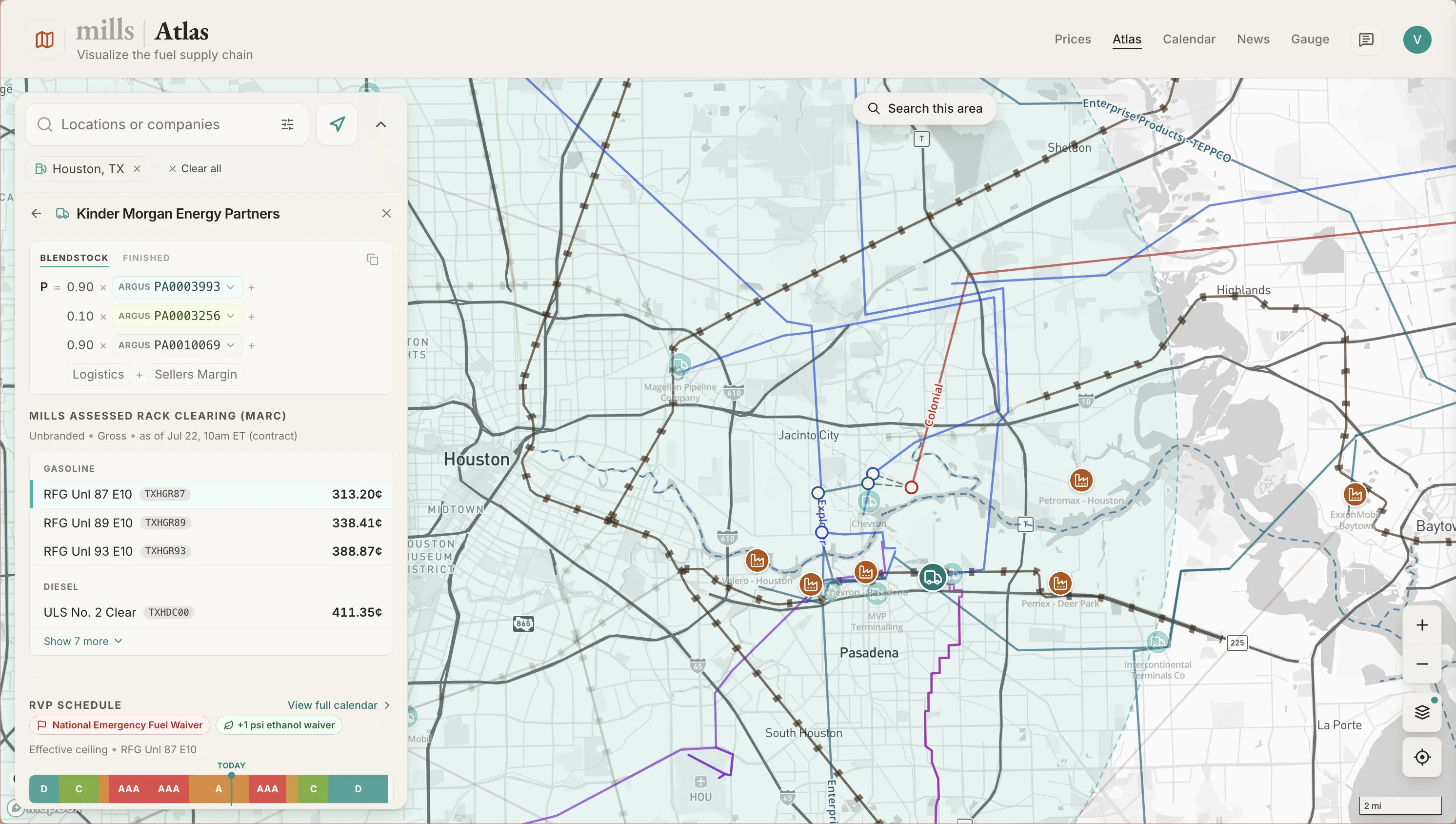
Wholesaler marketing reps and jobbers need to learn a market they do not yet serve, meaning who operates each terminal, who markets there, what specs it carries, what pipelines and barges feed it, what the tariffs are, which RVP ceiling binds, and whom to call, in order to enter that market and get a new rep productive. However, nobody has ever put those three layers together. The physical, the commercial, and the regulatory sit in separate places, the Stalsby directory died with OPIS, and a new hire learns the map from a senior person's memory, Google Earth, and cold calls.
Mills Atlas teaches the jobber the market by putting all three layers on one map, with every terminal, marketer, spec, tariff, interconnect, and RVP schedule in place, which results in a new rep oriented in an afternoon and a market entry scoped in a day.
Find the next buyer
Wholesalers and jobbers need to find new customers by identifying who owns tanks in a market, how much they hold, and what product they burn, in order to grow volume without waiting on referrals. However, prospecting today is Google searches, conferences, and word of mouth, and an account manager burns days per lead.
Mills Atlas accelerates the wholesaler by mapping tank owners, jobbers, and commercial end users with tank count, total volume, product type, and contacts, all accessible with natural language search.
See compliance risks coming ahead of time
Retail end users need to know which volatility ceiling binds at each terminal city on each day by resolving federal, state, county, and pipeline specs plus waivers into a single schedule, in order to plan seasonal supply and avoid buying a barrel they cannot ship. However, the rules live in four different places, secondary specs are hidden (83/85/91 octane, El Paso 7.0 RVP), and you can't move 85 octane from Salt Lake to Reno.
Mills Calendar, included free with Atlas, de-risks the retail end user by rendering every city and spec pair as a timeline with a lane per authority and the binding ceiling computed day by day, which results in transitions planned well in advance of the switch date.